On Sunday 27 September Averil Nottage will lead a walk called “Physicians, Fairs and Trams: a history of Pond Street and South End Green”, encompassing this area between Hampstead and Belsize. Here she provides a taster of what the walk will cover:
Pond Street appears in local records as far back as 1484, although its origins are probably earlier. The name Pond Street included not only the road but also the hamlet around the pond at its eastern end. In the early 18 century Hampstead became a fashionable spa and, as the only “quality” street in the area, Pond Street was a popular place for physicians and spa visitors to stay. Most of the houses were on the north side, with a wide slope of grass shaded by tall trees to the south. By 1800 it was described as the Harley Street of Hampstead.
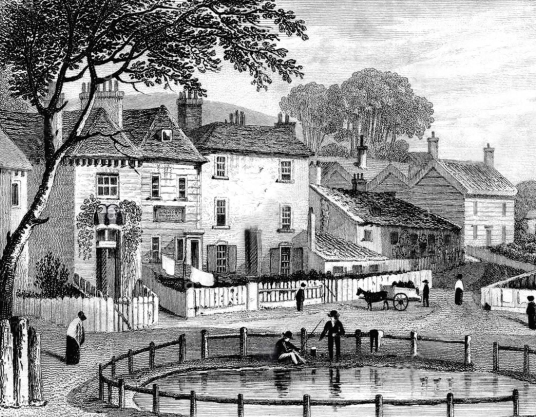
The pond was referred to as early as 1259. In the engraving above, from around 1828, it was surrounded by rustic houses and cottages. By then the pond had become very polluted and so it was filled in around 1835. Replaced with a green, it became known as ‘South End Green’.
After Hampstead Heath Station opened in 1860, tens of thousands of revellers swarmed from the East End to ‘Appy ‘Ampstead on high days and holidays and South End Green became a makeshift holiday resort. Donkey boys touted for trade, and peddlers sold everything from jellied eels to the latest novelties to the sound of the organ grinders. Gradually coconut shies, conjurers, stilt walkers, fire eaters and Punch and Judy shows appeared. By the late 1870s, steam merry-go-rounds and boat swings were open throughout the year in fields besides South End Green. In the taverns holiday makers would link arms or a knees-up or join in a boisterous sing-song, and the tea rooms overflowed.
The train line split the fields of South End Farm. After the Magdala pub opened in 1868 the roads to the north of the station, including South Hill Park and Parliament Hill, were developed. Parliament Hill Fields, also known as Traitors or Kite Hill, was a popular destination for the day trippers. It was bought for the public in 1889.
In 1886, South End Green became the terminus for horse drawn trams, and the road had to be widened, slicing through the Green. Tram lines enabled two horses to pull vehicles carrying twice as many passengers as omnibuses, making the fares cheaper. In busy periods trams arrived once a minute. A water fountain and public lavatories were provided for the day trippers, and a shelter for the tram staff. All three are now listed. The bus terminus at South End Green is a legacy of the trams. A depot for the horses and tramcars was built in Cressy Road. With hundreds of horses stabled there, a strong odour pervaded the air. It added to problems already plaguing the area around Fleet Road. The Fleet brook, which ran alongside the road, became increasingly polluted until it was incorporated into the sewers.
In the 1870s a fever hospital for smallpox patients opened on a site above Fleet Road and, although it was surrounded by a high wall, the area’s reputation for respectable housing was ruined. For many years other uses had to be found for the land – a brickyard, a large factory making paper napkins and doilies, a piano factory, a carpet beating ground, a laundry and the Fleet Road Primary School which opened in 1880. Gradually houses for the “lower middle classes” were built around them.
The walk will be on Sunday September 27th, repeated at 11.00am and 2.30pm. You can book your free place here.