This is the Eton Avenue Area Safe and Healthy Streets Scheme (IPO/2026/13)
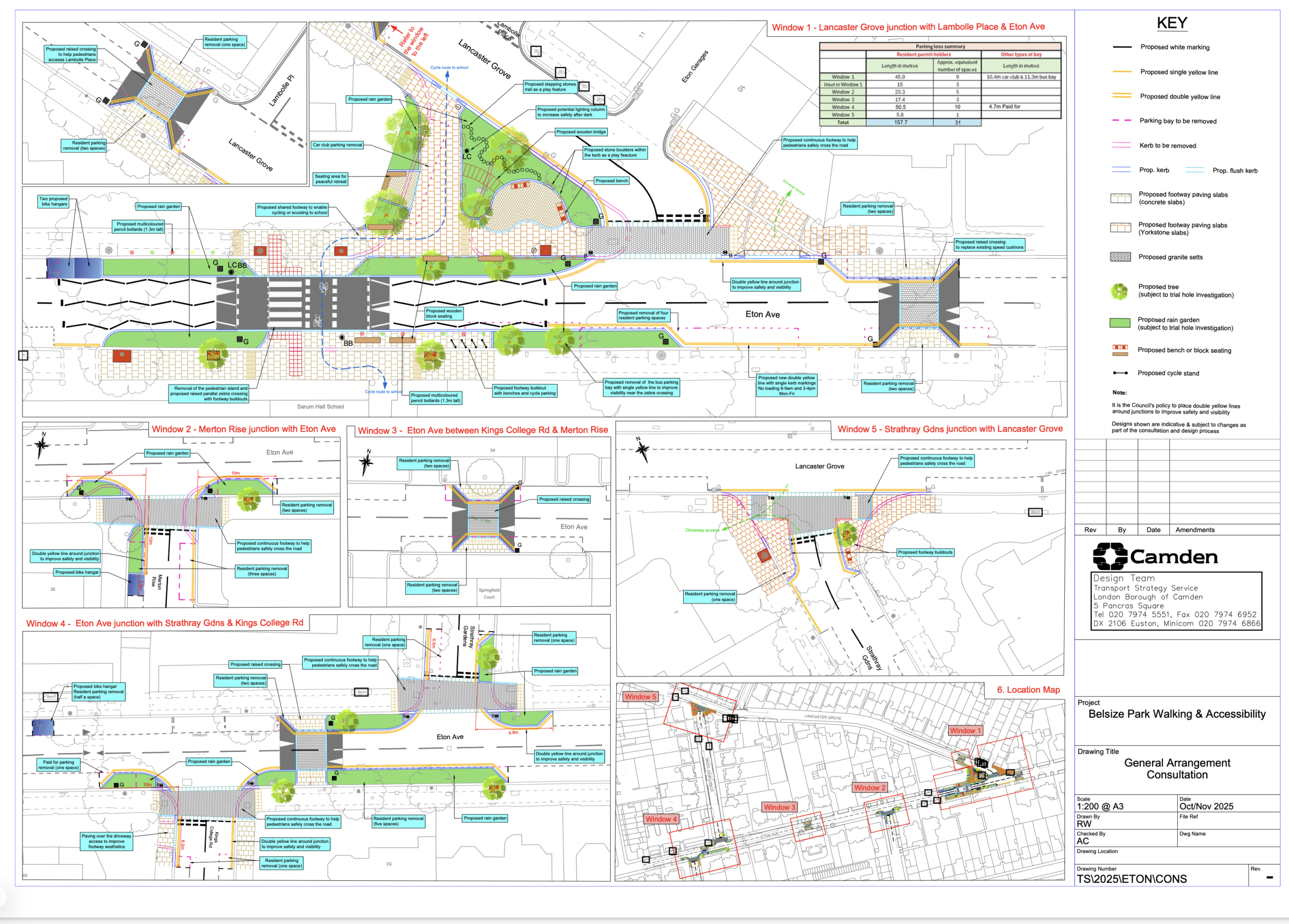
The final proposals are detailed here
The initial scheme with photographs and detailed plans is shown here
Following consultation earlier this year, the scheme as proposed will be adopted with some minor changes. Our councillors requested this to be ‘called in’ for consideration by the Culture and Environment Scrutiny Committee to be heard on December 3rd.
The Belsize Society made some comments about the scheme and still have some concerns. We shall possibly be making a deputation to present our objections but will require your comments (see below).
The overall aim of the work is to make it easier and safer to walk, wheel and cycle, lumped in with additional environmental concerns addressed by some ‘greening’, creating a ‘car-free public space with public realm’ and some parking ‘rationalisation’ (reduction). Encouraging a shift away from car ownership and use is part of the overarching Camden Transport Strategy.
Though many of the proposed changes might seem to offer obvious benefits for pedestrians and cyclists, like most of these types of ‘improvements’, no evidence is given for the particular need or the cost-effectiveness of the proposed scheme. So how was this particular street chosen and this particular scheme designed?
The decision to go ahead rested solely with the Cabinet Member for Planning and a Sustainable Camden who, according to Camden’s website, still seems to be Councillor James Slater. On November 16th he will likely be voted Leader of Camden Council following the previous leader’s election to parliament. (Presumably he will hand over his existing role: holding two such powerful positions would be of concern). On Camden’s website the last time this office posted any meetings was June 2018.
The delegation of significant decisions to a single member rather than consideration and vote by committee is a worrying anti-democratic trend. The scheme was drawn up with planners who, naturally would have recommended it to be accepted. Bypassing a committee to scrutinise and contest such plans is dangerous.
The scheme proposes various junction ‘treatments’ such as we see elsewhere: raised crossings with associated parking restrictions to improve sight lines, and pavement widenings with some planting and 14 new trees, joining the planted triangle with benches opposite Sarum Hall School to the rest of the pavement by taking out the short road between Eton Avenue and Lancaster Grove and adding a zebra crossing to the school. 4 new bike hangars are planned. A reduction in car speed is aimed at improving road safety.
Initially this scheme would have resulted in a loss of 31 residents’ parking spaces but following a lot of negative feedback this has been reduced to 17 mainly by reducing some of the ‘greening’ proposals.
The main feedback concerns are addressed in the document, to some degree.
Results of consultation
Notices were attached to lamposts and 704 letters delivered to properties in the immediate area affected but many local residents say they were unaware of the scheme until after the four week consultation period in early 2026.
There were 148 valid responses to the consultation.
Overall, including those outside the consultation area, nearly 65% disagreed with the proposals and 33% agreed.
60% of respondents lived within the consultation area and of those local residents, businesses and residents’ organisation nearly 72% disagreed with the proposals, just 26% in favour.
Significantly, over 76% of respondents had access to a car.
The cost of the scheme is at present £432,000 with funding from TfL and Strategic CIL (a levy on developments in Camden), nearly half of which is guaranteed, the remainder discretionary.
The scheme has now been ‘called in’
In view of the large amount of local disquiet over this scheme, our local councillors have requested this scheme be called in and reviewed by the Culture and Environment Scrutiny Committee. This will be heard on December 3rd at 6.30pm. BelSoc will be likely be asking for a deputation to be considered. For this we shall need your comments as soon as possible.
Many of the aims of this scheme are difficult to object to: we all want a safer, greener and more pleasant local environment, easier for people in wheelchairs and other mobility difficulties, pushing buggies, safer for children, improving air quality and reducing flood risks.
But will this scheme deliver those? Are there better options or design changes that are needed?
It is most unlikely the scheme as a whole can be stopped but can it be improved?
We need to hear your views.
Please send them to info@belsize.org.uk